Project Overview
The goal of this project is to create a free and open-source communication board that can be used by people with communication disorders.
Development Process
Implementation
The idea for this project came from a class I took in college about Augmentative and Alternative Communications (AAC). We learned about different types of devices that can help people with disabilities communicate effectively. I was surprised to learn how expensive some of the software solutions were. Even “free” apps lock essential features behind a $250 paywall. I don’t think people should be charged for having a disability so I’m trying to create a 100% free option.
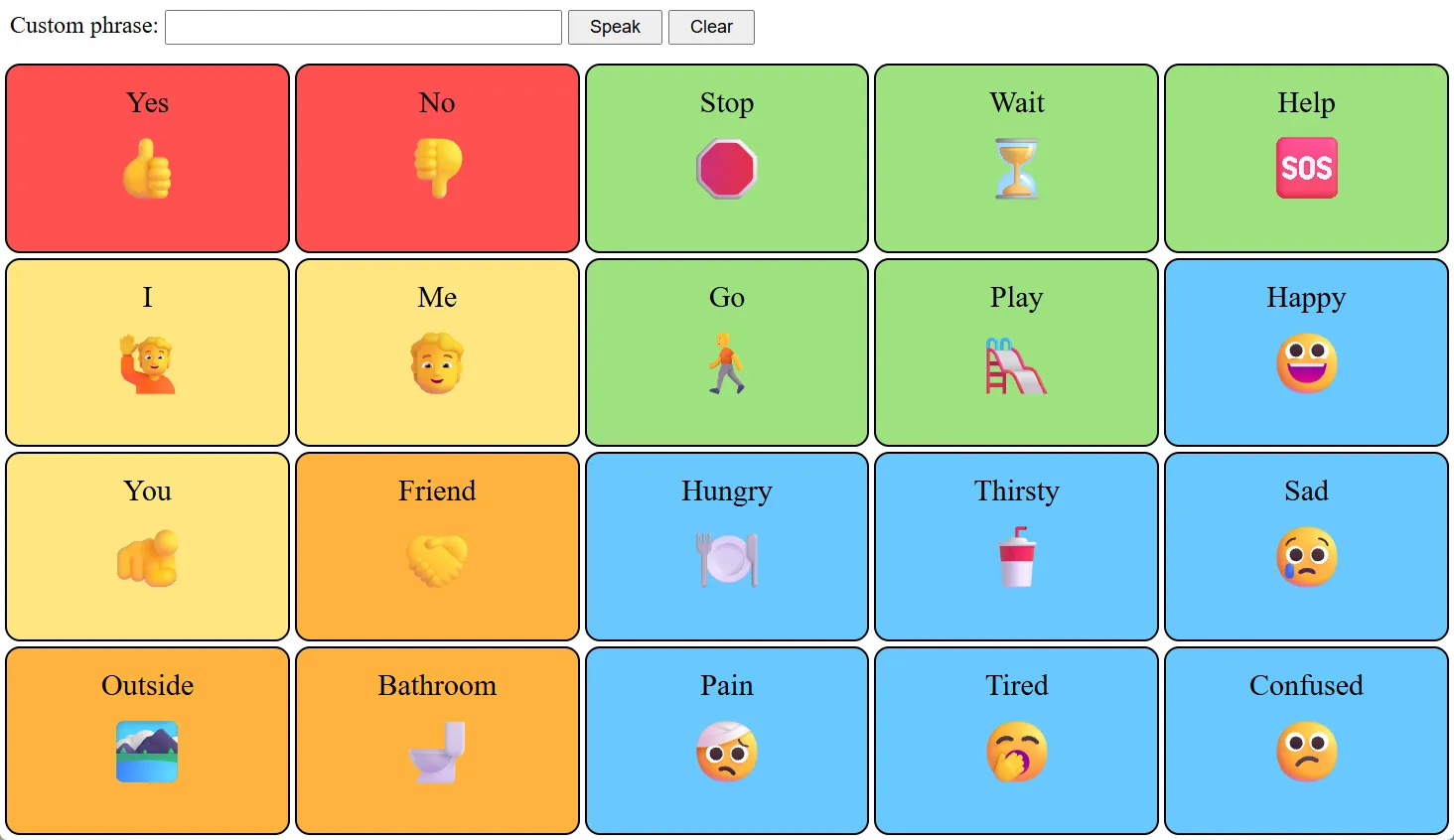
I started by creating a new file on my CodePen account so I could brainstorm. I created a grid layout and made clickable tiles that have pictures and a label. I added an onClick JavaScript event that calls a text-to-speech function. I also added a feature where the user can type a custom phrase that will be read by text-to-speech.
Challenges
- I had never used text-to-speech in a program before, so that was a learning curve.
- Finding simple, yet descriptive icons was difficult. The icons in this project are borrowed from various internet sites.
Conclusion
This project acted as a proof-of-concept for my communication board idea. From here, I’d like to turn this project into an application using a framework such as React Native. The app would then be able to run on any device locally.
Some features I’d like to add are customizable tiles, adjustable grid sizing, text-to-speech voice settings, folders, and multiple pages.
Update: October 2026
When I moved my portfolio off of Notion, I took the chance to clean this project up. The icons I’d borrowed from around the internet are gone, replaced with Microsoft’s open-source Fluent Emoji, and the code now lives in its own GitHub repository under the MIT License, so it’s truly free and open source. You can try the board live.
Next up: once the board grows beyond everyday words, I’d like to switch to Mulberry Symbols, an open symbol set designed specifically for AAC.